Research
Neutron stars, from the outside in.
My work follows information from a pulsar’s magnetic field, through its heated surface and rotating X-ray signal, to the properties of matter in its interior.
Magnetosphere
Physical maps of surface heating
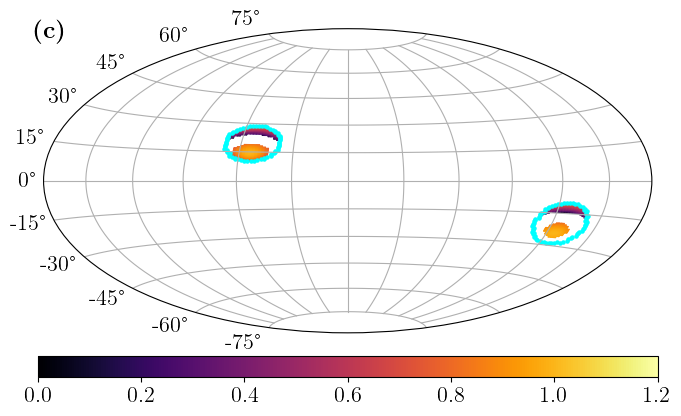
Pulsar magnetospheres carry electric currents that return to the stellar surface and heat localized regions. I develop analytic, physics-motivated models for these hotspots in displaced-dipole and multipolar magnetic fields. The goal is to replace purely geometric emission regions with surface maps connected to the exterior electrodynamics.
Physics-Motivated Models of Pulsar X-Ray Hotspots · ApJ 991, 90 (2025)
First-Principles Polar-Cap Currents in Multipolar Pulsar Magnetospheres · ApJ 999, 204 (2026)
Surface emission
Relativistic X-ray pulse-profile modeling
As a neutron star rotates, its hotspots produce a periodic X-ray signal shaped by the viewing geometry, special-relativistic motion, gravitational redshift, and light bending. I work on forward models that connect physical surface maps to these pulse profiles and on GPU acceleration that makes complex models practical inside Bayesian inference.
I also co-developed GPU-PPM, a GPU-accelerated X-ray pulse-profile modeling code designed for fast likelihood evaluation and Bayesian inference.
GPU-Accelerated X-ray Pulse Profile Modeling · Astronomy & Astrophysics 709, A111 (2026)
The interactive calculation on the homepage is a compact educational version of this forward-modeling idea. It uses generic parameters and contains no observational fit or unpublished result.
Interior
Model-independent inference and dense matter
I develop complementary ways to learn about neutron-star interiors. One line uses physics-informed equations of state—including nucleonic, hyperonic, and phase-transition models—within Bayesian inference. Another extracts canonical radii and tidal deformabilities directly from observational posteriors with minimal equation-of-state assumptions.
Infrastructure
Open scientific software and collaboration
I lead the development of CompactObject, an open-source Python framework for neutron-star equation-of-state inference. The collaboration brings together researchers in the United States, Europe, and China and supports projects ranging from relativistic mean-field theory to multimessenger constraints.
Earlier work
Glitches and nonlinear dynamics
My earlier research includes Bayesian model comparison for the long-term recovery of the Crab pulsar after glitches, tests of starquake interpretations, and undergraduate work on symmetry breaking in polygonal vortex flows.
Bayesian Insights into Post-glitch Dynamics · MNRAS 542, 3198–3205 (2025)